
Above: Proposed Vail Boulevard (South Frontage Road): Main Roundabout east to Blue Cow Chute illustrates proposed roundabout at the Crossroads Chute (Village Center Drive).
VAIL VILLAGE
HOMEOWNERS
ASSOCIATION,
INC.
President
- Alan Kosloff Secretary
- Ellie Caulkins Treasurer
- Patrick Gramm Executive
Director -
Jim Lamont
Directors: Judith
Berkowitz - Dolph Bridgewater -
Bob Galvin -
Ron Langley -
Bill Morton -
Gretta Parks - Richard Conn
To:
Alan, Kosloff, Board of Directors, Membership, and Interested Parties.
Mayor Rod Slifer and Members of the Town Council
From:
Jim Lamont
Date:
June 12, 2005
RE:
VVHA-Crossroads Redevelopment Report,
Town
Council Public Hearing
June
21, 2005
Introduction: The community has not, as yet, made up its mind
about the redevelopment of the Crossroads at Vail. There are several interests, which vigorously differ with
several aspects of the proposal. There
are others, with opposing views, which just as vigorously, argue their issues of
“community need.”
The community is in transition; no one faction can have its sway.
Therefore, compromise is necessary. What
should that compromise be? The
community is literally at a crossroads. The Crossroads project; whatever its final form will be a
compromise. This report explores
the potential grounds for a compromise that will allow for redevelopment of the
Crossroads at the Vail site.
The Vail Village Homeowners
Association is participating in the public process addressing the redevelopment
of the Crossroads Shopping Center in Vail Village. This report is a
reflection of our participation. The
reader now shares the issues put to the Association’s Board of Directors for
their consideration.
The project has been reviewed within the Association's “principles of good governance.”
It is the Association's principle that property owners in similar circumstances should
share common rights of property and zoning.
The Association's principles include a belief that the grants of “special
privilege” should not be given, whereby one property owner diminishes the
rights of his neighbor or others in the community.
Further, it is the Association's position that the Special Development District as
applied in the Town of Vail is and continues to be an abusive grant of special
privilege.
The Association recognizes that there arises from time to time, the need
to rectify deficiencies, physical and otherwise, in a neighborhood and the
community. Development can be a
worthy end to accomplish public benefit. However,
there is the potential for misunderstanding over what constitutes a “worthy
development” or “developer.”
The allocation of “developer
provided benefits,” because of the lack of definition about what is a
“public benefit,” makes the process prone to abuse.
The determination of “public benefit” requires the closest public
scrutiny. To avoid
difficulties about what are appropriate “public benefits,” the debate must
be transparent, open, and available to the public.
A clear distinction must be drawn between property owner improvements, which are required to reasonably do business and those that more directly benefit the “practical needs” of the public interest, such as roadway improvements. The responsibility to provide “public benefit” improvements belongs to the developer. In return, it is the responsibility of the public to make “necessary and practical” improvements, which have a direct relationship (nexus) to the impacts associated with the project.
The proposal is being judged from two perspectives, the relative size of
this proposal to its immediate predecessors in the zoning process and adjacent
neighbors. The second, the
breaking-of-new-ground on which future precedents will be set. The Town
Council has the final say on this matter.
Homeowner Association Position:
The Homeowners Association has approached this application from the
perspective that the Crossroads Center, as it currently exists, is in need of
being rebuilt. The manner in
which it will be rebuilt is the subject of public debate and consideration by
the Vail Town Council and the broader community.
The Homeowners Association has prepared this report, not as a final recommendation, but as informational advisory, representing the perspectives of it constituencies.
Conclusion:
The author remains to be convinced that the Crossroads at Vail project
has fully represented it impacts. The
zoning deviations appear to benefit the developer more than the public.
It
is suggested that the Board of Directors either individually or as the Board,
forward their recommendation with respect to the proposed compromise and any
other position of which they are desirous.
The
reader’s conclusions should be communicated to the Vail Town Council in the
form of an email, FAX, or standard letter.
Communications with Town Council Recommended:
Contact Vail Town
Council: Email:
towncouncil@vailgov.com;
Voicemail: 970-479-1860; Fax: 970-479-2157; US mail: 75 South Frontage Road
West, Vail, CO 81657.
Contact Vail
Village Homeowners Association:
In
order of priority: Email;
vvha@vail.net, web
site; www.vailhomeowners.com,
Voice Mail/FAX; (970)
827-5856, Post Office Box 238,
Vail, Colorado 81658
Crossroads Issues of Controversy:
The factors being decided must consider circumstances as they presently
exist or as they may reasonably exist in the future. The specific issues that remain controversial are as follows.
1.
Height:
Is the building too tall in comparison with its surroundings?
2.
Building
Bulk and Mass: Is the apparent size of the building too large in comparison
with its surroundings
3.
Public
Benefits - Zoning Deviations verses Public Benefits: Is
there ample restitution for extraordinary costs to the public infrastructure and
other relevant matters resulting from the development, as compared to the zoning
concessions being required by the developer?
a.
If public benefits are not sufficient how much should the density and
height be reduced or should the payment for public costs be increased?
4.
Architectural
Style and Design: Does the architectural
style of the proposal have a compatible aesthetic relationship to the adjacent
properties, neighborhood, and the community-at-large?
5.
Special
Development District: Should
the project be approved under the provisions of the Special Development District
or remain as, Commercial Service Center, its standard (underlying) zone district
designation?
6.
No
Hotel Rooms:
How many hotel rooms should be provided in the project?
7.
Additional
Conditions of Approval: Are
there additional conditions that should be attached to approval of the project?
The recommendation by the Planning Commission and Town Staff are appended
to this report.
Link:
PEC Public Hear Summary with Conditions of Approval 4/25/05
Link:
Crossroads Town of Vail Staff Report April 25 2005
8.
Legal
Issues:
a.
SDD/Special Privilege: Is it a grant of “special privilege” and does
the Town of Vail have the legal authority to modify zoning regulations through
the application of Special Development Districts, whereby zoning standards are
altered for a particular property in exchange for financial or other types of
compensation or restitution paid by the developer to the town?
b.
Master Plan Compliance: To what degree is the Town of Vail bound to comply
with adopted master plans and what is the process for master plan adoption and
amendment?
Discussion:
Legal Issues: The
zoning for the project is proposed as a Special Development District.
The history of Special Development Districts in Vail has a stormy legal
legacy. The District Court has
rejected at least two court challenges against the Special Development District.
The most recent conflict resulted in a punitive financial judgment
against the plaintiffs, who were adjacent property owners.
However, it is the opinion of some legal authorities that the judgment
had no bearing on the validity of the Special Development District as a valid
method of zoning.
The court’s remedy, should flaws have been found with any Special
Development District, is to remand the matter back to the Town of Vail for
rehearing so that the flaws may be corrected.
This could mean that only a portion of the process would have to be
cured, or in the extreme, that the deficient application would have to be filed
again, as a new application, and the matter reheard by the reviewing bodies in
the Town of Vail.
Special Development District must prove Public Benefit: The
developer is using the Special Development District zoning classification so he
can obtain deviations from the development standard of the underlying zoning
district. The determination of
deviation is based on a set of criteria, which must be satisfied before approval
can be granted. One of those
criteria requires proof of public benefits.
Proof of public benefits has come to mean a sum of money or resources
that offset the cost to necessary public infrastructure and quality-of-life
facilities.
SDD Review Process Flawed:
The Special Development District approval process allows the avoidance of public
scrutiny through the application of “contract negotiation” procedures.
The approval process for a Special Development District (SDD) is a
negotiation between the Town and the developer.
It is a bargaining for “public benefits” in exchange for
“deviations” from the zoning regulation.
The zoning designation for a SDD site is known as the “underlying zone
district.” The negotiation usually results in increased density and the
exceeding of other zoning standards of the “underlying zone district,” such
as height, setbacks, parking, etc.
The Town considers its deliberation about “public
benefits” to be contract negotiations and therefore, subject to executive
privilege. The Council holds its
substantive deliberations about public benefits in executive session.
The Town Staff are the “gatekeepers” of the negotiation process.
They make recommendation directly to the Town Council in executive
session. The staff maintains an
exclusive franchise over the negotiation be enforcing a condition that “ex
parte” contact between public officials and their constituents on matter is
prohibited. The public is
“frozen out” of the negotiations process.
“Ex parte” contact typically applies to the deliberation
of judges and juries. The Town
Staff enforcement of “ex parte” contact, allows written communication to
occur. Personal contact can be made
but the Councilperson is subject to legal challenge, if they take a public
position “for” or “against”
the proposal, prior to officially taking public testimony.
The Town staff conducts pre-meetings briefing with the
planning commission and other authorities that discusses arguments in favor or
against a SDD proposal. Tactical
strategies are also discussed in these sessions. Official minutes or a report are not kept of the
pre-meetings. The time and location
of the pre-meeting is included in the published agenda of the Commission or
Board.
Point of Compromise: Residents,
citizens, and property owners have the right to directly discuss the proposal
with members of Commissions, Boards, and the Town Council.
All discussions regarding terms of contract will be held in public
meetings at which the public can attend. The
meetings must be electronically tape recorded for the public record.
The details of discussions between two or more Council members must be
reported electronically on the public record within 24 hours.
Developer Claimed Public Benefits:
Central Plaza: The Crossroads developer is proposing as one of his
public benefits, the creation of a large central plaza.
The density that could have been built on the footprint of the plaza has
been replaced on to the residential wings, causing them to be higher than the
allowed 38’ building height for its underlying zone district.
Point of Compromise:
The relocation of density above height limitations of the underlying zone
shall not be considered a public benefit. Relocation
of density above height limitations shall be subject to proof of public benefit
and restitution.
Commercial Uses: the developer is claiming
commercial uses, such as the movie theaters, bowling alley, and other commercial
use as public benefits. Many
believe that these are not public benefits, but are necessary costs associated
with attracting guests and customers. Many
interests believe that the proposal does not meet the required test of having
sufficient public benefit.
Point of Compromise: The building must contain one
floor commercial uses.
Point of Compromise: Cultural and recreational amenities, available to the general public, including community use, should be considered a "partial" public benefit.
Other Claimed Public Benefits:
There are other claimed public benefits that are identified in the Town
of Vail staff memorandum, a copy of which resides on the Homeowners
Association’s web site. The following
are other points of compromise by category that should be considered by the
Council.
Point of Compromise: Higher priority should be required for public benefits, which improve “necessary” public infrastructure and safety.
Affordable Housing:
Point
of Compromise: An
equivalent of at least one floor of the building must contain a mix of
affordable housing, which provides domestic living units for full-time
residences, who are multi-aged, including those needing elder or special
care, which will house, families, children, couples, and single persons.
Environmental:
Point
of Compromise: The
building must be build to LEEDS certified "green" building
standards.
Mass Transportation:
Point of Compromise: The building owners must participate in the future construction of utilities and infrastructure improvements, such as a mass transit system and roadway improvements.
Parking:
Point
of Compromise: Developer provided parking spaces, available to the general public
and community use, should be considered a “partial” public benefit.
Point
of Compromise: Subterranean interconnection of parking structures is considered
a public benefit for reasons of traffic and life safety.
No Hotel Rooms in the Proposal:
The residential portion of the Crossroads will, according to the
developer, operate as a condominium hotel, having traditional hotel guest
services, like a front deck, restaurants, etc.
The Town of Vail has not legal power to require condominium units to be
made available for short-term occupancy, like a hotel room.
The Vail Plaza and Fours Seasons Special Development Districts both are
required to provide hotel rooms. In
these developments it was considered a “public benefit” to provide hotel
rooms in the development. The
amount of hotel rooms over an above that required by the underlying zone
district should be considered a public benefit.
Point of Compromise: The building must contain one
floor of hotel rooms.
Point of Compromise: Relocation of density for hotel rooms above the 38”height
limitations shall be subject to the proof of public benefit and restitution.
Height, Setbacks, and Density are Public Benefit/Political Decisions:
The height, setbacks, and density of the
development is a political decision made by the Town Council.
The costs, associated with public benefit improvements can be compensated
for by increasing the height of the building, reducing building setbacks, and
increasing the allowable density.
The relative height of the proposed Crossroads project is
similar to the Special Development Districts for the Vail Plaza Hotel, now under
construction, and the Four Seasons scheduled to begin this autumn.
Other factors are variable among the three projects.
There is no foolproof guarantee that these projects will
accomplish their economic intent. Historically,
shifts in national and international markets can readily deflate anticipated
demand in a local real estate market. An
approval, for a project that has not gone into construction, having a
development program that is “out-of-demand,” could be more of a hindrance
than anticipated.
One of the arguments being made by the Crossroad’s
developer is that the relocation of density from the area he is proposing to be
a plaza, should then qualify as a public benefit.
The proposed plaza is being built, on land scheduled to be built upon, in
according with the Town of Vail’s master plan.
The developer in the process of relocating the density
allocated to one part of the site to another comes into conflict with the height
requirement. The height limitation
established for the proposed Four Seasons and Vail Plaza Hotel, have similar
provisions. Limitations identified
by the Town’s Master Plan have been overturned.
The developer is claiming that by retaining the density and
providing a plaza he is doubling the public benefit. He does not recognize that he is merely displacing the impact
from one locale to another. He may
be exacerbating the impacts because he is creating a high-rise development that
places different and greater impacts upon the public infrastructure.
Point of Compromise: Reduce further the height, bulk, and mass of the project.
Point of Compromise: There is no substantive public benefit when density is relocated from one portion of a site to another, if in its relocation it violates other zoning standards.
Point of Compromise: The relocation of density allocated to the plaza area cannot be
located above the 38’ height limitations of the underlying zone.
Point of Compromise: The relocation of density above height limitations of the underlying zone district shall not be considered a public benefit.
Traffic Considerations:
Traffic is one of the most important considerations that must be decided.
Traffic engineers have analyzed the intersection of the South Frontage Road
and Crossroads Chute (Village Center Drive). The additional traffic
generated by the Crossroads redevelopment will push the traffic capacity to
near unsafe conditions at the intersection.
The South Frontage Road, adjacent to the proposed project is one of the
busiest and most important stretches of road in the entire community.
Above: Proposed Vail Boulevard (South Frontage Road): Main
Roundabout east to Blue Cow Chute illustrates proposed roundabout at the
Crossroads Chute (Village Center Drive).
Studies conducted for the Vail Front Door Project indicated a
traffic stress point at Vail Road and Meadow Drive, which could have a
deteriorating ripple effect, not only at this intersection, but the Main Vail
Roundabout, as well. Gridlock could quickly appear.
Major investment must be made to ensure that the entire
downtown is as free as possible from gridlock.
The proposed Crossroad’s roundabout would provide an alternative route
to disperse traffic should an unforeseen problem arise.
The Crossroads roundabout insures the continuation and usefulness of a
“limited access” traffic route between Check Point Charlie and the
Crossroads Chute over the International Bridge.
The Crossroads developer has agreed that he will finance a
quarter of a roundabout for the Crossroads Chute and South Frontage Road.
Traffic engineers agreed that a roundabout intersection would increase traffic
flow and reduce safety problems associated with the Frontage Road. The
cost of the intersection is estimated at $2 million.
The Crossroad roundabout intersection improvement must follow
on as one of the first phases of the project. The completion of the roundabout is critical to reducing the
truck traffic, which uses the new streetscape improvements that are now being
installed on Gore Creek Drive, Bridge Street and throughout the immediate
neighborhood.
The specific location for the roundabout remains under study,
as it must be designed to handle bus traffic entering the adjacent bus station.
It may require a substantial retaining wall on its north side.
These and other public infrastructure items have been laid on
the project's budget.
Point of Compromise: The project causes the traffic safety of the intersection between the Crossroads Chute (Village Center Road) and South Frontage Road to become jeopardized, therefore, the Crossroads developer is to pay the full cost of the Crossroad’s Chute roundabout and fix a date certain for its completion, within 12 months of the approval of the application.
Loading and Delivery System:
Crossroads, has agreed that it will use its enclosed
truck-loading terminal as a member of the "dispersed
terminal system." The purpose of the "dispersed terminal"
system is to distribute goods throughout the commercial establishments
in the Vail Village neighborhood.
Point
of Compromise: The
building owners must agree to participate in the dispersed terminal loading
and delivery system.
The Cost of Public Benefits Determines the Building’s Height and Size:
The developer, in obtaining his permission from the Planning Commission to
proceed for Council review, reduced the size of the building both above and
below ground. The reduction underground, removed a substantial
number of for sale or leased parking spaces, and the family entertainment center
from the plan. What remains are the movie theaters and bowling alley.
Above ground, the developer has made an attempt to reduce the height of building
to be more compatible with it neighbors. As public benefits are attached
to the project, the bigger the building becomes.
Existing Site:
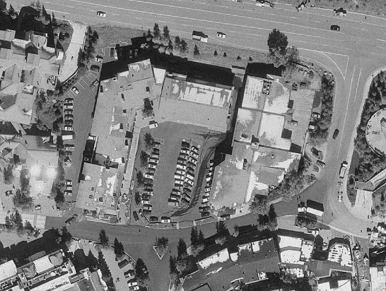
Aerial Photo: Existing
Site
Architecture Style:
Point of Compromise: Building architecture should be
of a traditional or romanticized alpine theme.
The
style, while Alpine, distributes its bulk and mass in the configuration of a
traditional Atlantic City beachfront hotel.
The configuration does not necessarily reflect the characteristics of a
European alpine mountain resort hotel.

The architectural design concept has changed since the first proposal.
The original design of the building facades was a high-tech,
tailored alpine modern. In response to criticism, more stone and wood
surfaces have been amended to the design, seeking to give the
impression of a more romanticized architectural theme. Gables have been
added to break up the profile of the roof.
Of the two proposed schemes, the “contemporary design,” is the most
successful. The contemporary
proposal was considered too great a contrast with the Sonnenalp and
other surrounding buildings that have the more traditional European design
styles of the 1970's and 80's. It should be assumed that the
more traditional buildings in the immediate area would remain.
The proposed structure, no matter the style, in its present
configuration, will dominate and “overshadow” the neighborhood.
Many are of the opinion that the revisions have not been as
successful as anticipated. Specifically, there is a desire to reduce the
apparent height and massiveness of the facade.

South Elevation:

East Elevation:

West Elevation:

North Elevation:
Crossroads - Main Plaza:

Point of Compromise:
The design for the plaza should be taken from examples of some of the
oldest public squares in Europe. The
plaza should contain canopies of deciduous trees that share the public space.
The canopy should be grown in areas created where groves of Aspens can
thrive. The plaza should be a
sanctuary for pedestrians and winged wildlife.
In winter, the trees could support a dramatically lighted canopy, which
shelters the ice skating rink.
Point of Compromise: The ice rink, its sunscreen, and fountain are to be considered
public benefit, subject to replacement, operations, and management
agreements with the Town of Vail and property owners.
Point of Compromise:
There is no substantive public benefit when the developer claims as a
“public benefit”, those “streetscape improvements”, which are necessary
and reasonable to conduct the business of the development.

The apparent height and massiveness of the building are intended to be
mitigated by a large plaza. The
plaza is to contain an ice skating rink, and provide ample frontage for two
commercial floors of business frontage arranged along a two-story arc on the
north side of the plaza.
The plaza design is carnival, to a fault. It is near empty of permanent landscaping, most particularly
trees. To date, there has been no
explanation of how the ice rink will be screened from the melting rays of the
sun summer or winter at 9,000 feet elevation.
In all likelihood, the ice rink will require a large fabric canopy that
is not shown on the plan.

There is a preoccupation with putting no obstructions to
interrupt the view of the storefronts from the adjoining pedestrian street,
which is East Meadow Drive. Ample
opportunity exists to shape the landscaping to insure that public spectacles,
planned for the space, will not be inordinately obstructed.
Bulk and Mass: The
building is being proposed as a unified architectural theme. Unity of architectural theme, a repetitive roof form and
uncomplicated geometry are increasing the apparent bulk and mass of the
proposal. A more “village like”
appearance, with multiple romantic themes, could contribute to reducing the
apparent bulk and mass.
Point of Compromise: Reduce further the
bulk and mass of the project.

Above:
Computer animation of the bulk and mass of the proposed Crossroad
compared with the Vail Village Inn and the Vail Plaza Hotel to the west.
 |
 |
||
Above Right:
Computer animation of the Crossroads proposal looking west along South Frontge
Road with VVI/Vail Plaza Hotel and
Four Season in the background
Height: The
developer is proposing a roof height at the peak of 98 feet, which is a height
that is precedent setting. The
Four Season SDD approval allowed a precedent setting height of 89 feet.
The following computer animation shows the amount
of building above the height of a fixed plane. The computer generated floating matrix shows the zoning
permitted height of 38 feet. At
the required height the proposed Crossroads building will be “in scale” with
it neighbors, as the “relative” heights of nearby buildings being near
equal.
Point of Compromise: Reduce further the
height the project.
 |
 |
 |
 |

Above: Illustrates the amount of
building area above the zoning 38’ height limitation.


Above:
Illustrates the amount of Crossroads building located above a computer
animation matrix at 89’. A
computer animated matrix analysis shows that the proposed height of the
Crossroad proposal is a precedent setting 98 feet.
The West Wing - Height relationship of the Crossroads West
Wing with adjacent VVI:
The graphics below illustrates the controversy with the neighboring Vail
Village Inn.


 |
 |
Relative Setbacks and Height Conflict: The illustrations show the setbacks and relative height between the West Wing of the Crossroads and the Vail Village Inn. The magnitude of the Crossroads incursions dwarfs those of the immediately adjacent buildings of the Vail Village Inn on Meadow Drive. The Crossroad appears to close off Meadow Drive. The setbacks should be more similar between the two projects so that one does not dominate at the expense of the other. The vitality of pedestrian movement along Meadow Drive is dependent upon unblocked visibility.
Point of Compromise:
The south façade of the West Wing should be stepped-down further and
kept to the same setback line as the adjacent structure at the Vail Village Inn
facing East Meadow Drive.
Stair-Stepping Height Minimal: The effect of minimally stair stepping from the frontage road to Meadow drive is evident on the Crossroad proposal. The West Wing in particular should hold to a similar height as the Vail Village Inn. It appears that the 38’ height limitation should be enforced on the West Wing of the Crossroad proposal.
Point of Compromise: The West Wing should be stepped-down; it should keep to the same step-down profile of the adjacent structures at the Vail Village Inn.
Point of Compromise: Meadow Drive frontage, Crossroads West Wing, remove two “step
back bays” from the West Wing so that the “setback” of the street
facade is the same for Crossroads as it is for the VVI. Reduce the height of third bay to a height corresponding
to the adjacent structure at the Vail Village Inn. The height of the west wing should follow the profile of
the adjacent structures on the Vail Village Inn site.
 |
 |
 |
|||
Point of Compromise:
Meadow Drive View, West Wing, removed two-step back bays of the West
Wing. Reduce height of third bay in
similar slope of adjacent commercial/residential structure.
The height of the west wing should follow the profile of the adjacent VVI
residential structures.
Points of Compromise:
Subterranean interconnection of parking structures is considered a public
benefit for reasons of traffic and life safety.
Precedents for Increasing Building Height:
The relationship of height among the three
projects, under construction or approved, along the South Frontage Road are
similar. What differs between them
is the stepping-down of height between the South Frontage Road and Meadow Drive.
Crossroad is proposing less stair stepping and retains a greater height
on Meadow Drive, with less of a setback from the property line.
The precedent setting height has been justified because the building will
become a sound barrier for Vail Village to the traffic noise from the adjacent
Interstate 70. The height that
has been approved for the Four Season, Vail Village Inn, and Vail Plaza Hotel
far exceeds the height necessary to block I-70 noise pollution.
 |
 |
 |
Comparison of
Height of Crossroads with Vail Village Inn:
The Crossroad
proposal has proportionally, significantly more occupied area at a greater
height than the Vail Village Inn. The
amount of space is obtrusive and not readily apparent from drawn building
elevations. The result of
overlaying of the Vail Village Inn and Vail Plaza Hotel with the proposed
Crossroads partially illustrates the differences.


Comparative View Study of Height, Bulk, and Mass - Computer Graphic Photo Montage: The following illustration shows a before and after comparison of the views of the site.
Point of Compromise: The
developer has shown some public officials a larger selection of the images as
well as others.
All images should be available to the Town Council and general public
prior to the approval of the application.

Before and After
View From Main Vail Roundabout:

Before and After View from International Bridge:

Before and After View From East Meadow Drive Looking
East:
Additional
Information is available on the Association’s website.
Please
forward to appropriate parties.
Post
Office Box 238 Vail,
Colorado 81658
Telephone: (970) 827-5680
Voice Mail/FAX: (970) 827-5856
e-mail: vvha@vail.net
web site: www.vailhomeowners.com